Magnificent Salon or Pivot Mirror
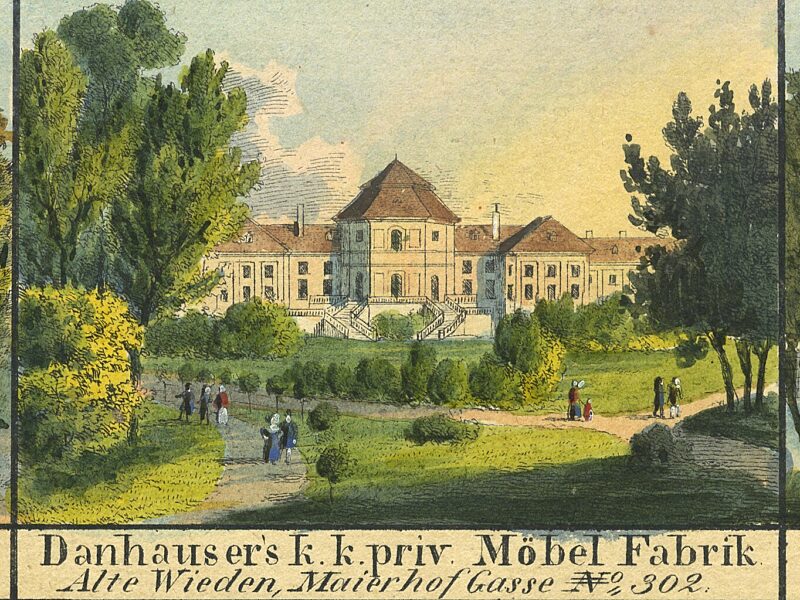
This pivoting mirror, which can with certainty be described as a courtly piece of furniture from the first third of the 19th century, is a masterpiece of the design language of its time and reflects in a perfect manner the style and quality of Danhauser. The Danhauser Imperial and Royal Privileged Furniture Manufactory (“Danhauser‘schen K&K privilegierte Möbelfabrik”) is considered the most important furniture manufacturer in Vienna of that era.
The richly carved floor mirror, partly decorated with molded ornamentation, is finished in dark green and embellished with rich gilding. The grand mirror stands on pairs of feet connected in an arched form, which are made in paw form and each decorated with a large gilded acanthus leaf. At the center of each pair of arched feet is a very finely executed medallion with a beaded border, adorned with a courtly portrait head with an updo in the Roman style.
The two round columns supporting the mirror are adorned with gilded foliage and ring decorations and are each crowned by a small amphora. Between the two columns is an oval element with a trefoil decoration, through which the hand-forged adjustment screw passes to secure the pivoting mirror in the desired position.
The mirror frame itself is decorated all around with small trefoils and is lined on its reverse side with yellow silk. The floor mirror is crowned with a semicircular crest, decorated with fine elements arranged in a radiating pattern. The piece is topped by a small amphora on which stands a fully sculpted figure poised dynamically atop a globe, looking upward toward the sky.
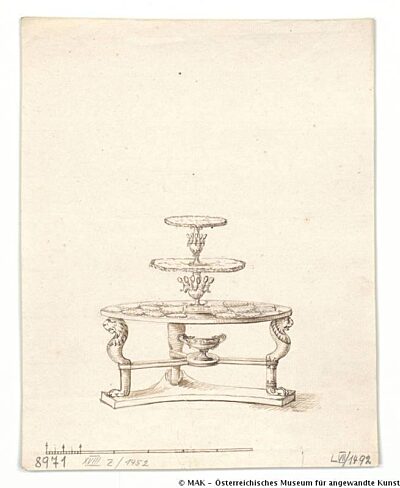
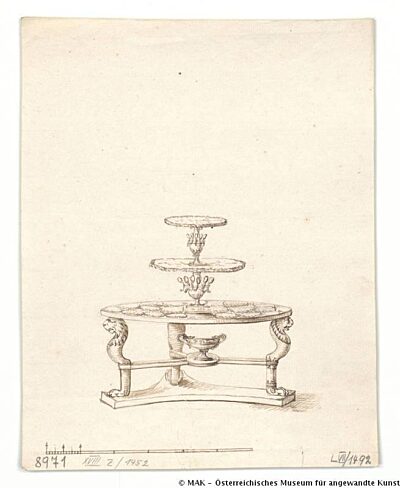
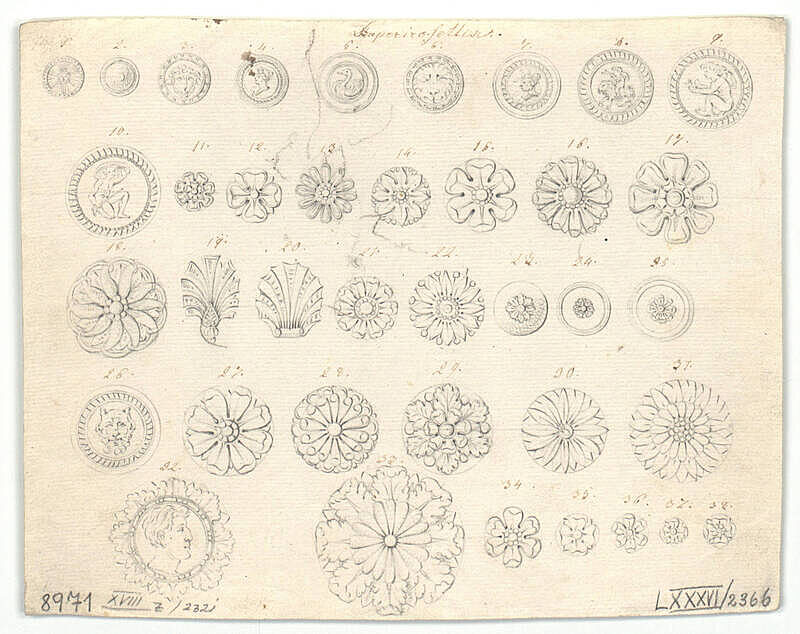
Similar designs can be found in the drawings of Josef Danhauser (see below), which today form part of the MAK collection in Vienna.
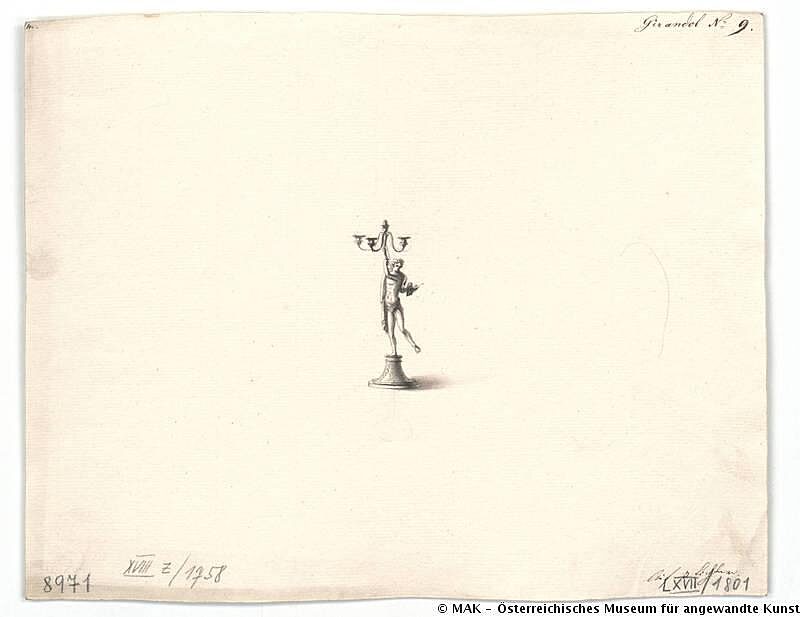
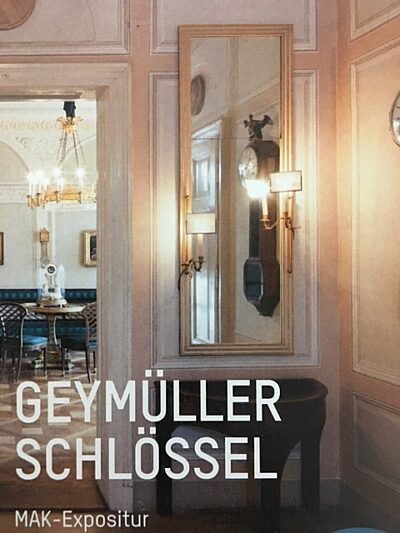
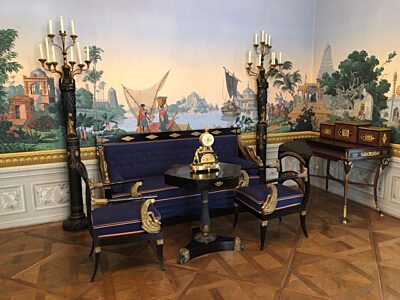
The “Geymüller Schlössel,” an event venue in Vienna, shows comparable candelabra (see below) in its on-site collection. The Biedermeier mirror presented here is an excellent example of the elegance and aesthetic of Viennese design in the first third of the 19th century. As in all earlier eras, there were exceptional craftsmen who demonstrated a remarkable sense for proportion and form, resulting in objects of the highest craftsmanship with great attention to detail. These masterpieces were primarily reserved for courtly and aristocratic clients.
The Austrian Museum of Applied Arts in Vienna (MAK) owns the majority of the drawings of the “Danhauser Imperial and Royal Privileged Furniture Manufactory,” comprising more than 2,500 drawings and sketches from the pattern catalogue. This catalogue included, among other things, 153 chair models, 56 daybeds, 179 types of chandeliers, and 124 window curtains. All these models were consecutively numbered within their respective product groups, with the lighting section divided into twelve groups … Please see images below.
The Danhauser furniture manufactory was founded in 1814 by the sculptor Joseph Ulrich Danhauser (1780 – 1829). It was one of the first companies in Vienna active in the field of interior furnishings. Thanks to a special production license, Danhauser was able to integrate all trades related to interior outfitting and carry out the necessary work under one roof. This included, above all, furniture-making and upholstery, the production of interior lighting, metalwork, elaborate curtains and bedframes with their fittings, as well as small sculptural accessories.
The manufactory’s clientele came from across the Austrian monarchy and from Germany, and the company maintained distribution branches in Graz and Budapest. Danhauser’s most prestigious and extensive commission was the renovation of the palace of Archduke Karl (today the Albertina) around 1822.
The Danhauser factory occupies an outstanding position in the history of Viennese furniture construction and interior decoration. The development of the Viennese furniture style can be traced through Danhauser’s designs, which initially followed French models such as those by Percier and Fontaine, but soon adopted an independent character.
Personal note:
This lavishly executed mirror was, in all likelihood, a commissioned work for a high-ranking aristocratic client. The present mirror is almost certainly one of the most decoratively designed pivot or floor mirrors that Danhauser is likely to have produced for his clients in this form in his workshops. Comparable models, mostly in somewhat simpler execution, are held in museums and private collections.
As mentioned above, one of Danhauser’s most important patrons was Archduke Carl, who between 1822 and 1825 commissioned furnishings for his palace, today’s Albertina in Vienna. Danhauser received the commission to produce new furniture for the entire palace and to execute the ornate parquet floors for the state rooms.
At that time, the Albertina was the largest Habsburg residential palace in Vienna …
Another significant and comparable example can be found today in the Schlossmuseum Gotha, in the so-called Napoleon Room. Alongside two important candelabra, the lavish Empire bed executed by Danhauser is preserved there— the very bed in which Duke Ernest I of Saxe-Coburg and Gotha (1784 – 1844) died in 1844 …
Comparables:
Albertina, Vienna:
https://www.albertina.at/en/co…
https://www.albertina.at/site/…
As well as, at the Foundation Friedenstein in Germany;
https://www.stiftung-friedenst…
Bedroom of Duke Ernst I of Saxe-Coburg and Gotha: